5 years after publishing the dsTNC modem, I finally found a moment to develop the project further. Please forgive the modest documentation page, but I'm still working on the project and splitting my time between professional duties, family and hobby. So please bear with me. The dsTNCv2 project had its premiere at the APRS enthusiasts meeting - Tama 2017. Here you can take a look at the presentation. Artur SP3VSS recorded my presentation at Tama APRS 2017. I'm not particularly happy with how the presentation turned out; I had a cold and was presenting with a fever :-(
Why? I wanted to have a TNC/iGate that simultaneously supports 1200 and 9600 (of course when connected to an appropriate radio with a so-called "flat audio" output), which would allow a slow migration and operation in 2 systems simultaneously.
As a bonus, I made it easier to chase weather sondes, since I always have the radio and dsTNC with a Bluetooth interface in my car and I only need to change the VFO frequency to decode the sonde position in real time during the chase. For Android users I recommend the APRSDroid app.
Instead of a Bluetooth interface, you can solder in a pre-programmed ESP01 module and you have a fully autonomous iGate - all you need is a WiFi network and a radio with an antenna :-)
Current project status
KISS and TNC2 (text) protocols via serial port or Bluetooth
AFSK 1200 modulation/demodulation (980 frames from test track)
IGate (using ESP01 module and firmware by Krzysiek SP9SKP)
TODO
Publish documentation :-)
Bootloader
Configuration :-)DONE! (see FAQ, SV1 connector description)
GMFSK modulator filters
Pilotsonde GRAW demodulation
Rebuild AX25 network stack (buffers/queues)
New APRS DIGI
Automatic Bluetooth HC-05 module configuration DONE! Only requires a piece of kynar wire Applies to PCB REV1
Improve GMFSK mode compatibility with various radios DONE!
Automatic signal normalization and automatic phase detection (if necessary).DONE! Additionally, you must replace C10 and C11 with 2.2 uF Applies to PCB REV1
$0 - callsign configuration (tracker, APRSNG and radiosonde object source) - in CALLSIGN-SSID format. If the callsign should have no SSID, enter CALLSIGN-0
$1 - radiosonde object transmission rate limiting - value in seconds defines the time between consecutive frames pushed to igate. 0 - every frame is transmitted
$2 - radiosonde object transmission rate limiting to iGate
$3 - Modulation 0 = 1k2 AFSK, 1 = 9k6 GMFSK
FAQ
What programmer do I need?
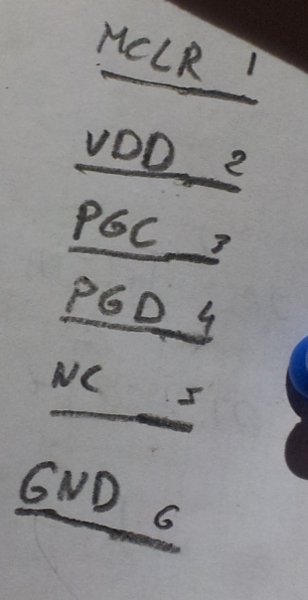
Unfortunately, programmers for more advanced PICs are not that popular. To program the processor you will need a Microchip programmer (or a Chinese clone): PICKIT2, PICKIT3 or ICD3. Applies to PCB REV1:
Please note the programming connector pinout - you need an adapter (pinout here). Sorry about that, but I made a cable and got so used to it that I can't part with it. I promise that in the next PCB version the connector will be compatible with the PICKIT series ;-)
How do I connect this gadget to a radio?
I thought it was obvious from the schematic ;-) The connector is designed so that dsTNCv2 can be used interchangeably with TinyTrak. DB9 connector pins:
pin 1 - radio input mic or 9600
pin 3 PTT - open drain
pin 5 - radio output flat audio
pin 6 ground
pin 7 optional power supply from the radio side
9600 and RS41 decoding doesn't work - what should I do?!
For decoding to work properly, dsTNCv2 must be connected to the "flat audio" output of the radio. This port is most commonly labeled PACKET 9600. A standard audio output (like the headphone jack on a Baofeng) is not suitable for this purpose - the received signal is cut off by the de-emphasis filter, which makes it impossible to reconstruct its original shape.
What is the SV1 connector for?
It's a diagnostic RS232C port (CMOS level) 1-RX, 2-GND, 3-TX. You can connect a USB to RS232 cable (3v3 level!!!), configure a terminal program to work at 115200 bit/s and monitor received frames. You can also configure the modem:
$0=SP9UOB-0
[$0] My callsign set to: SP9UOB-0
$1=15
[$1] RS41 rate limited to 15 secs
Can I use WiFi and Bluetooth simultaneously?
No. You must choose which connectivity you want to use with the modem and install the appropriate module.
What do the LEDs mean?
LED5 - Power
LED4 - DCD
LED3 - heartbeat
LED2 - TX
LED1 - unused (any ideas? :) )
LED7 - Bluetooth
LED6 - Bluetooth connection
What is the WiFi password and how do I set it up?
After programming the ESP01 module, it starts in configuration mode. It broadcasts an SSID:dsTNC network with the password 123456789. The module defaults to address 10.0.0.1 and that's the address you should enter in your web browser. Connect to the above network and configure the module for your own WiFi network (SSID, password). Note! Currently you cannot use spaces in the network name (Krzysiek will probably fix this). Additionally, you must statically configure the IP address, Gateway and DNS - at this point the module does not support a DHCP client. Version ESP4dsTNC_1.01.bin includes a DHCP client. Of course, you can still statically assign an address to the device.
How do I connect via Bluetooth?
dsTNCv2 configures the Bluetooth module to broadcast with the name dsTNC. The default HC-05 module pairing PIN is 1234. dsTNC does not change the PIN, so if you set a non-default one - that's the one you'll need for pairing.
Why does the voltage regulator get so hot?
Because when powering the modem from 12V, the regulator has to dissipate almost 1.5 watts of power. To simplify the design, I chose an LDO regulator instead of a switching converter.
The device will not be damaged when powered from 12V, but powering it from 5V is recommended.
If you have questions - feel free to send me an email. Please remember though that I'm quite busy and may respond with a delay :-) 73! DE Tomek, SP9UOB.
If you are interested in a PCB or a pre-programmed processor - please contact me as well.
If you like my project, you can support it by making a donation: